Blog
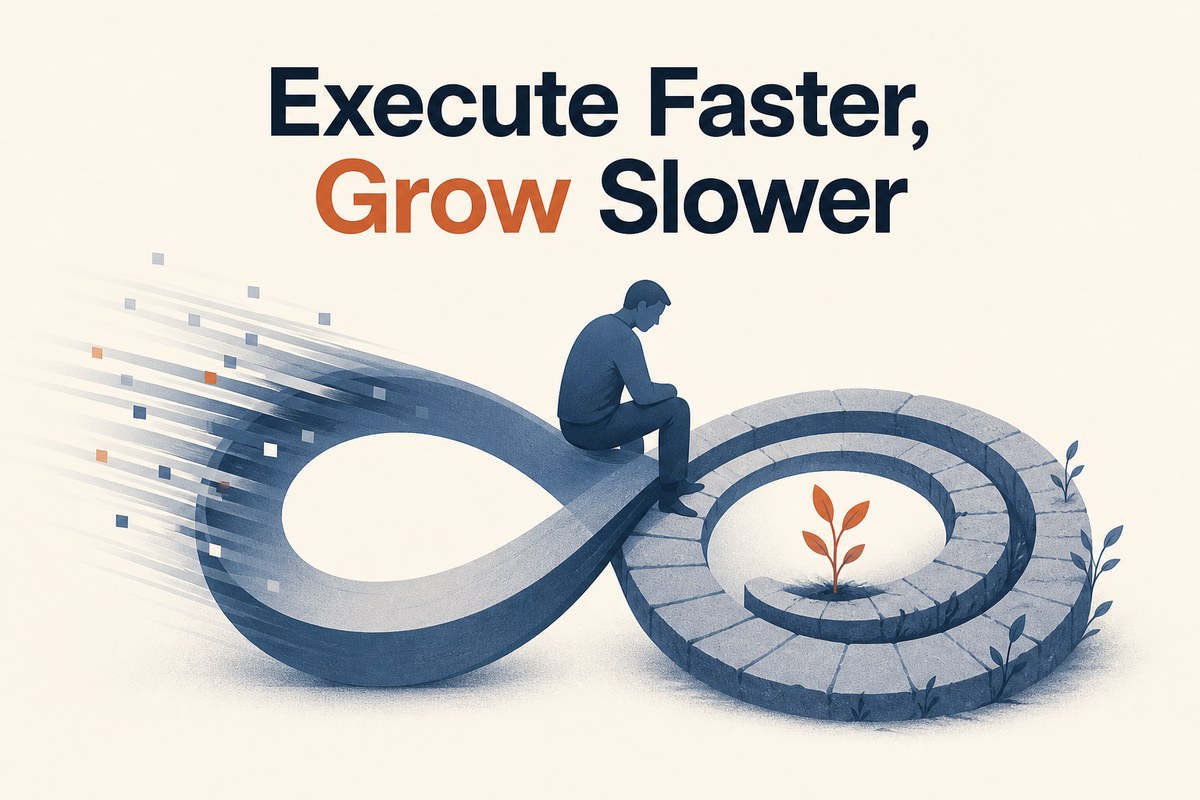
AI Is Making It Easier to Execute, and Harder to Grow
AI is always available, always encouraging, and always ready to help. It takes rough thinking and turns it into something polished in seconds. It shortens the path from idea to execution in a way that feels efficient and impressive.
Now picture this at home. One of your kids walks in and announces that they are going to build a ramp in the driveway and jump their bike over the trash cans because it is going to be awesome. You do not shut it down. You ask them to walk you through it. They explain the angle, the speed, and the landing. You ask a few steady questions about what happens if the front wheel dips, where they plan to land, and how they will slow down. Eventually they ask the question every parent hears: can you just help me set it up?
You could. It would be faster and probably safer. Instead you tell them that if you did it for them, they would not learn how to think it through.
So they measure and build the ramp, give it a try, crash once, and then go back to adjust it. After a few more attempts, they finally land it on their own. Somewhere between the hard fall and the clean landing, they recognize that the real thrill was in building it and attempting the jump, and that clearing the trash cans was not worth the risk. No one tells them that. They arrive there themselves. That judgment forms because they stayed in the problem long enough to learn from it.
Now imagine AI standing in the driveway. It calculates the ramp angle, the approach speed, and the landing distance. It recommends materials and lays out a step-by-step plan to maximize the odds of success. The jump is engineered before the first attempt, and the rough edges are smoothed out in advance.
When AI helps us execute, we may skip the learning that happens in the driveway. At work, that can look like moving quickly from a half-formed idea to a fully engineered plan, where the output improves and the rough edges are smoothed out. What can quietly disappear is the part where judgment is formed.
I use AI every day. This is not an argument against it. It is a reminder to be deliberate about when we let it accelerate us and when we choose to wrestle with the idea ourselves.
Sometimes the most important lesson is not how to clear the trash cans, but realizing, through the work, that you do not need to jump them at all.
Recommended next
Related work
What an AI Prototype Revealed About Enterprise Knowledge
Internal knowledge existed but couldn't be retrieved reliably. Broad AI experimentation without guardrails risked exposing sensitive content. A focused prototype tested value and security at the same time.
Related conversation
Vibe Coding vs. Real Engineering: AI As Help, Not Hope
"Vibe Coding" has become a popular way to describe building software by simply chatting with an LLM. It feels efficient, but it often lacks engineering rigor. In this episode, Ben Griswold (Grizen) and Noah Heldman (OutcomeSource) discuss the difference between this casual app…
Author
More like this