Blog
Broad Models, Narrow Problems
Most companies are not building AI systems. They are handing employees tools like ChatGPT and Claude and calling it transformation.
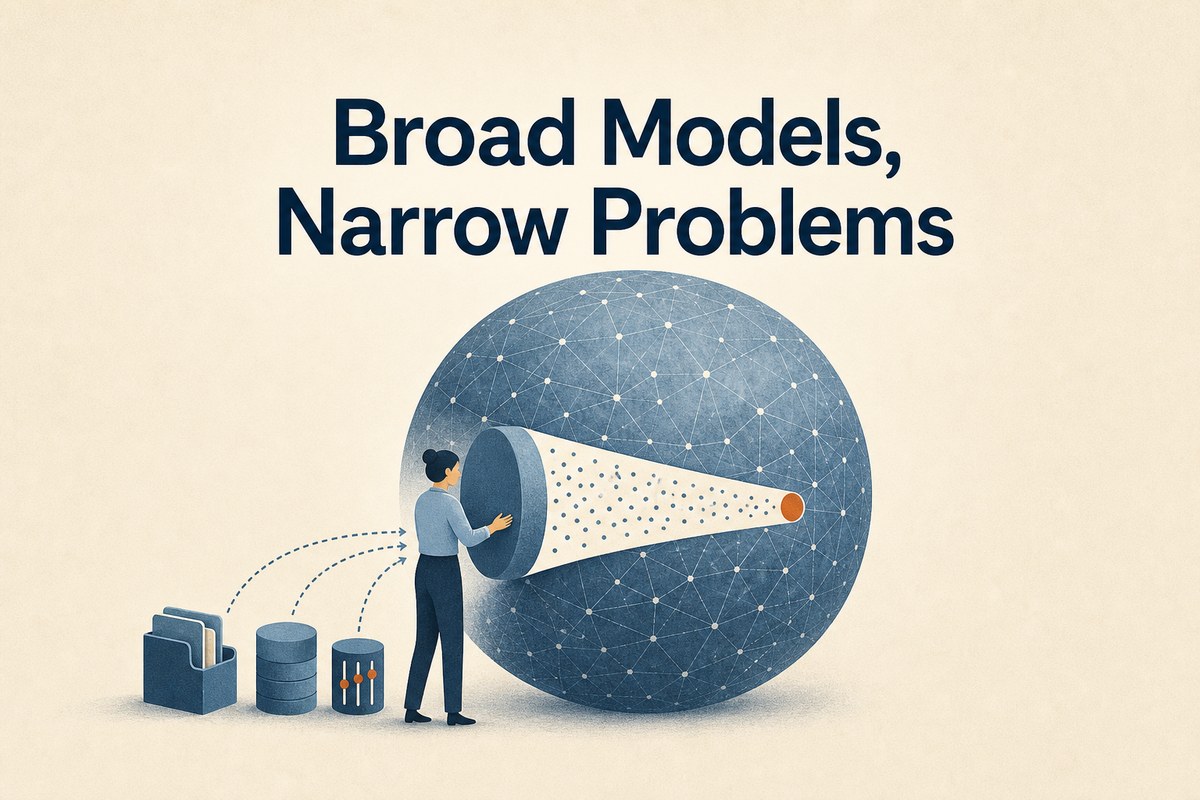
Underneath, most of this is powered by large language models designed to reason across a massive, open-ended space. Most business workflows are not. They are narrow, repeatable, and constrained. That mismatch shows up quickly.
Prompts get longer. Outputs vary. People retry until it looks right, and someone still has to check the work.
Custom GPTs, better prompts, and agents help. They are still operating inside a general system. If the problem is not constrained, neither is the outcome. The output looks impressive. It feels fast. It is not a system.
The more experienced teams narrow the problem before they ever call a model. Sometimes that means pulling in only relevant data through retrieval-augmented generation. Sometimes it means fine-tuning or using smaller models where the decision space is already well understood.
The point is not to replace large models. It is to stop using them where they are doing more than the problem requires. Every time you ask a broad model to figure it out, you are paying for it in tokens and retries.
Using AI is easy. Designing the system around it is where the transformation actually happens.
Originally published on Substack.
Author
More like this